
Sports Business College athletics
Tennessee Wrote a College Sports CBA Down. Here's What It Gets Right, and What It Can't Fix.
A cap, a floor, a retention pool and a real transfer window. It isn't a deal. It's the most detailed template college sports has seen.
 Powered by Westview Market Intelligence
Disclosure: HoopThink is affiliated with The Westview Group, which also does athlete-representation and NIL-related work.
On Tuesday, Nov. 10, Tennessee men's basketball player representatives and Athletes.org released a model collective bargaining term sheet. It is not a signed agreement or a ratified CBA. Athletes.org says Tennessee's administration has not agreed to or endorsed the terms, while AP reports the model comes with the support of school leadership. Both can be true. There is no union and no binding structure yet.
The player reps are Tyler Lundblade, Campbell Duncan and DeWayne Brown II. Athletic director Danny White reviewed the proposal, and he has said collective bargaining is where college sports is heading.
So don't read this as a deal. Read it as a template, and the most detailed one college sports has seen. Every other Power Four program can now copy it, rewrite it or ignore it.
The argument just moved from "should there be rules for paying athletes?" to "which rules?"
The Core Idea: Service, Not Influence
The centerpiece is a single Universal Athletic Services Agreement that would replace revenue-share deals and today's patchwork of contracts. Players would be paid for athletic services, not influencer deliverables.
NIL pays for promotion. Revenue sharing hands out money without representation. A service agreement brings rules, representation and accountability. College athletics has spent years dressing up pay for play as something else, and this proposal drops the costume.
The Money: Cap, Floor, and a Reason to Stay
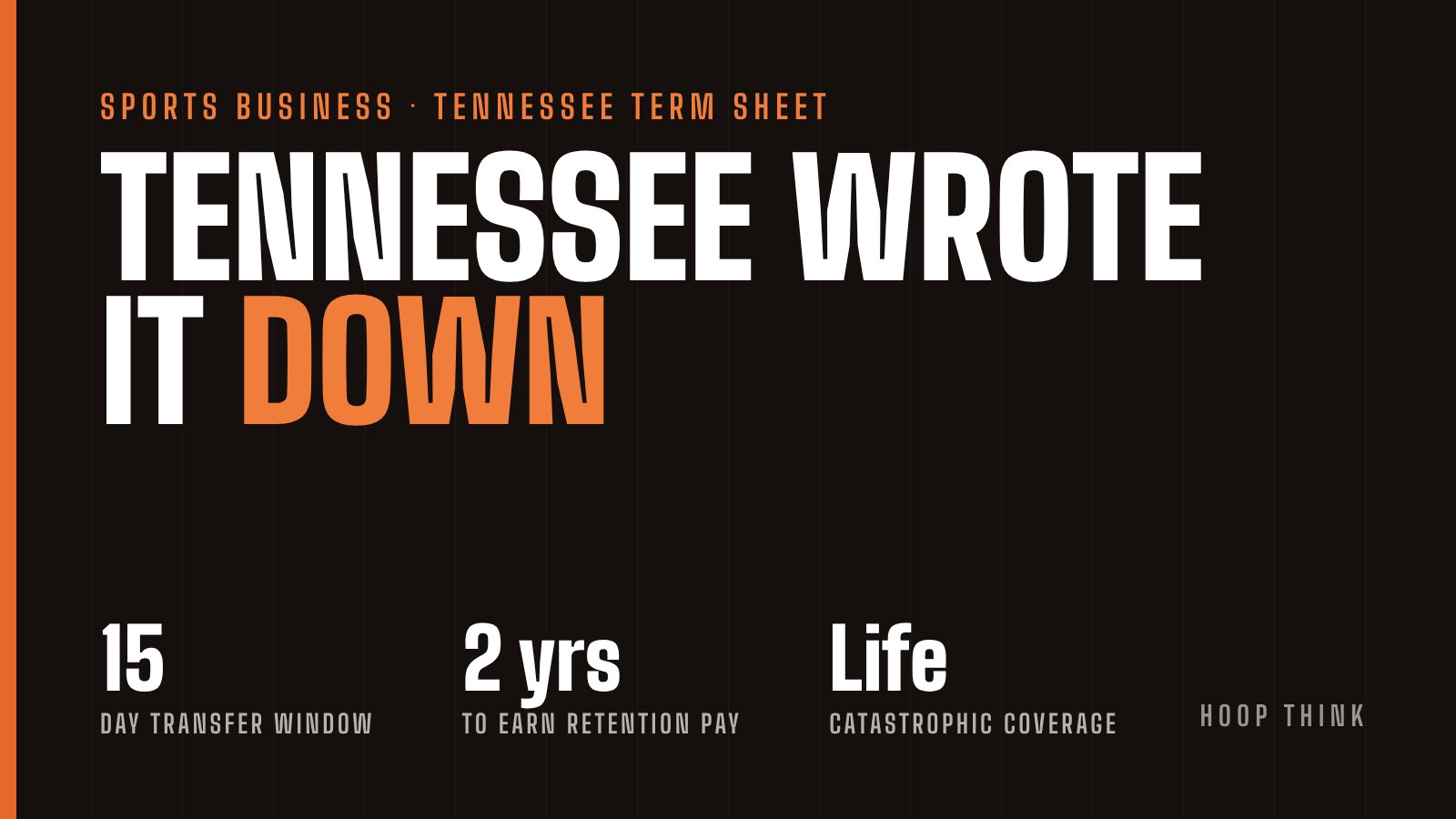
The structure pairs a salary cap with a spending floor and guaranteed minimums for players. It adds postseason revenue pools and player performance pools, plus a retention pool for athletes who stay, and play, at the same school for at least two years.
The current system rewards leaving: the highest bidder, the loudest collective, the best portal leverage. A floor plus a retention pool flips that. If you stay and build something, you get paid for it.
Movement: One Window, With Teeth
The term sheet calls for a 15-day transfer window that opens at least one week after the national championship game, backed by anti-tampering rules and a five-year eligibility clock. A window only works if what happens outside it has consequences. This one is built to be enforced.
Protection
- 🛡️ An independent grievance process with a neutral arbitrator
- 🛡️ Guaranteed pay on injured reserve
- 🛡️ At least two more years of health coverage after eligibility
- 🛡️ Lifetime coverage for catastrophic injuries
That reads like an employment relationship. It treats the athlete as a worker putting their body on the line for the school's business.
Agents: Regulate It
The term sheet also proposes a centralized agent registry, caps on agent fees and certification. You can't have a service agreement and then let anyone take a cut for making a phone call.
Three Questions, and My Read
1. What legal weight does a school-by-school contract carry if players aren't employees?
My read: less than the headline suggests, and more than skeptics admit. Without employee status, a recognized bargaining unit or a labor exemption from Congress, this isn't a CBA in the legal sense. It's a private contract a court could enforce. It can't solve antitrust or Title IX on its own, and it can't force other schools to follow it. Doing it school by school means you don't have to wait on Washington, but you get a patchwork unless conferences or Congress build a framework around it.
2. Who wins and who loses under a cap and floor vs. today's revenue-share model?
My read: the floor helps the middle of the roster, the rotation players who make a season work but never land a shoe deal. Retention rewards programs that value stability. The cap costs the top of the market. The one or two players who could start a bidding war would likely make less, and collectives lose their leverage. That's predictability and protection for most, with a ceiling for a few. Whether that's a good trade depends on whether you see college basketball as a league or an open market.
3. What does football do with this?
My read, and it's a read, not reporting: football has the most money and the most risk, so it will wait to see what basketball survives. Smaller rosters and shorter seasons make basketball the easier place to test it. If it holds up legally and politically, football moves fast. If it blows up, football will say it was never serious.
Why This Matters Below College
The portal doesn't start in college. Tampering, backchannel calls and "we have a spot if you don't like it there" conversations start in high school and on the grassroots circuit.
A real transfer window with enforceable anti-tampering rules would change more than college rosters. It would change what a 15-year-old's recruitment looks like, who gets to talk to him, and what families can expect once he arrives. A retention pool changes the pitch, because "stay and get paid" is a different promise than "come here and see what the portal offers next year." Regulated agents mean fewer bad actors in the room when families are making decisions.
Grassroots programs, high school coaches and families should be watching this closely. This is where their kids end up.
Where It Leaves Us
Tennessee didn't sign a CBA. It wrote one down, and that moves the argument from "should college sports have rules for paying athletes?" to "which rules?" Either we build something that protects players, rewards staying and gives families a clearer path, or we keep stacking workarounds until the next lawsuit knocks them down.
Your call: would you trade a ceiling on the top of the market for a guaranteed floor for everyone else?
 Sports Business is powered by Westview Market Intelligence.
Keil Moore is the Managing Partner of The Westview Group and Editor-in-Chief of HoopThink, The Intelligence Layer of Basketball. He is a former ESPN National Recruiting Analyst and former Director of Scouting at ProspectsNation.
Sources
- AP via WPXI: Tennessee players, Athletes.org release model CBA term sheet
- Front Office Sports: Tennessee basketball's model collective bargaining agreement
- USA TODAY via Yahoo Sports: Tennessee basketball's CBA blueprint could solve college sports' biggest problems
- RG.org: Tennessee Players Propose College CBA Term Sheet